Introduction
Hypocrisy and Dissent concerns a controversy that occurred in the first half of the 1990s at the Findhorn Foundation, a registered charity located in northern Scotland and considered by many to be the leading New Age centre in Europe, a counterpart to Esalen in California. My review was originally published in the August 1996 edition of Network, the journal of the Scientific and Medical Network. Other positive reviews appeared at the time. The local Forres Gazette described it as ‘a searching and sharply-observed book’. Writing in The Christian Parapsychologist (Vol. 12, No. 2, June 1996, p. 63), Canon Michael Perry summed it up as a ‘sorry tale of how an idealistic group of ecologically-motivated people turned themselves into a typical cult’.
Revisiting my review after almost twenty-three years, I realized it would benefit from an explanatory introduction. Not only was the original limited by the spatial constraints of the journal, but there have been further developments concerning the events described in the book. Other critical accounts of the Foundation have been published too, such as John Greenaway’s In the Shadow of the New Age: Decoding the Findhorn Foundation (London: Finderne Publishing, 2003), and Kevin R. D. Shepherd’s Pointed Observations: Critical Reflections of a Citizen Philosopher on Contemporary Pseudomysticism, Alternative Therapy, David Hume, Spinoza, and other subjects (Dorchester, Dorset: Citizen Initiative, 2005). The following paragraphs, therefore, are intended to provide both some context for my original review and an update.
My personal interest in the philosophy and sociology of religion began in 1988, the year of my graduation, when a friend recommended an introductory book on Buddhism by Christmas Humphreys. Over the next few years I read widely on religious topics and observed several religious groups in Ireland and the United Kingdom. My philosophical background gave a critical edge to my reading, and I was particularly keen to learn about the effects of conditioning, indoctrination, submission to authority, and so on. As a teenager I had been fascinated by the 1980 television miniseries about Jim Jones, and I later became acquainted with the outrageous behaviour of so-called gurus like Rajneesh (Osho) and Sathya Sai Baba. More salubrious was my correspondence with renowned Benedictine monk, Bede Griffiths, whom I met in 1990 at his ashram in southern India.
When I visited the Findhorn Foundation in 1994, therefore, it was more as a critical observer than a participant. The best way for me to achieve this was to enrol in the residential induction program known as Experience Week. This program typically includes team-building activities, tours of the various Foundation properties (including a ‘pilgrimage’ to the ‘shrine’ of the original co-founders’ caravan), and work experience in the gardening, homecare, kitchen, or maintenance departments. Another fixture at the time of my visit was a talk given to the group by figurehead Eileen Caddy (d. 2006), the only co-founder still resident. It was the ‘voice’ heard by Eileen that had guided the co-founders in the early days (i.e. from 1962). All in all, it was enough for me to witness in person many of the things I had heard about, and which would also be described in Castro’s book: the sort of people drawn there, the commercial ‘workshops’ on offer, the organizational structure, the daily routine, and some activities that are distinctive to the Foundation (the regular ‘attunements’ mentioned in my review, for example).
The first half of the 1990s was a time of unprecedented media scrutiny for the Foundation, fuelled by two controversial developments. The first of these was the increasing role of commercial therapies in the program. The most contentious was ‘Holotropic Breathwork’ (HB), the trade name for a therapy developed by Czech psychiatrist Stanislav Grof, following the legal suppression of his research into the effects of LSD on psychiatric patients. It is a form of hyperventilation that induces altered mental states via changes to blood chemistry, with unpredictable results and sometimes extreme side-effects. It was introduced at the Foundation in 1989, under the directorship of Australian Craig Gibsone. Alarming effects were reported by participants and witnesses in Foundation precincts. These were known to include vomiting during sessions, and post-session disorientation and psychological disturbance requiring remedial psychotherapy. The leading opponent was Kate Thomas (d. 2017), who documented the entire episode in a lengthy chapter of the third volume of her autobiography, The Destiny Challenge: A Record of Spiritual Experience & Observation (Forres: New Frequency Press, 1992). She described how other Foundation community members had strong doubts about this experimental practice, including Eileen Caddy, who significantly failed to make her misgivings publicly known. The Foundation attempted to ban the book, but their solicitor pointed out that there was no legal case.
In a 1993 article in The Scotsman, Dr Linda Watt of Leverndale psychiatric hospital in Glasgow, who had studied accounts of HB, cautioned that hyperventilation could cause seizure or lead to psychosis in vulnerable people. The Scottish Charities Office (SCO) became involved and commissioned a report into the effects of hyperventilation by Anthony Busuttil, Professor of Forensic Medicine at the University of Edinburgh. Based on this, the SCO recommended suspension of the HB program at the Foundation. The latter complied officially, but authority figures exacted revenge on the dissenters. Although her position had been vindicated, Thomas was expelled from associate membership without a hearing. Her associates received similar discriminatory treatment. These events are at the heart of Hypocrisy and Dissent.
In 2006 I became involved in a sequel to the HB controversy, when I modified the Wikipedia article on HB to include sections on criticism of the practice and on the contraindications listed by Grof himself. Although I adhered to Wikipedia guidelines, I ended up in an ‘edit war’ with HB defenders, which eventually exposed broader problems with sectarianism on Wikipedia. I documented this at ‘Wikipedia and Kevin R. D. Shepherd’. The HB article no longer exists, having been subsumed into a more general Breathwork article.
The second controversial development was an increasingly expansionist policy within the Foundation, which aroused the suspicions of the indigenous populations of Findhorn and Forres. Relations with the locals had often been strained, particularly with the swelling of visitor numbers from the 1970s. Spokesman for the locals was the formidable Sir Michael Joughin (d. 1996), the chairman of Scottish Hydro-Electric, a former Royal Marine lieutenant, a past president of the Scottish National Farmers Union, and a justice of the peace. In 1992 a leaked memo revealed plans for the acquisition of land and an expansion of business operations. Although the plans were later dropped, the episode confirmed the local suspicion that the Foundation was serious about building a ‘vast city of Light’, as predicted by Eileen’s ‘guidance’. Along with Holotropic Breathwork, the planned expansion was the subject of a two-page spread in The Guardian (see Richard Boston, ‘If only the spirit could move them’, The Guardian, 11 November 1992, pp. 10–11). The article concluded: ‘In recent weeks the foundation has suffered one setback after another. The plan to launch a public company has been dropped, the holistic health centre has been abandoned, and the attempt to stop Kate Thomas’s book has failed. The foundation is under attack from without, and is divided and demoralised within. All in all they’ve got themselves into a right old mess.’ Undeterred by the setbacks, however, the Foundation was in the national press four years later, this time because of ambitious plans to establish an ‘eco-village’ (see Amanda Mitchison, ‘Invasionary forces’, The Sunday Telegraph Magazine, 24 November 1996, pp. 12–19).
As critics like Greenaway and Shepherd point out, these controversies sprang from the same root cause, which was the transformation of the Foundation from a small group of idealistic (if eccentric) seekers, interested in alternative lifestyles, into a commercial centre for New Age therapies. In Chapter 2 of his book (‘Transition to Managerialism’), Greenaway dates this change as early as the mid-1970s, although the formation of New Findhorn Directions in 1986 was the impetus for the ‘strong commercial drive of the Foundation of the 1990s into the new millennium’ (In the Shadow of the New Age, p. 44). He finds that this ‘growing managerial and commercial culture drew strongly on ideas and methodology taken from successive phases of “New Age California”’ (p. 44). The major influence was the Esalen Institute at Big Sur, founded in 1962, coincidentally the same year that Peter and Eileen Caddy, along with Dorothy Maclean, established themselves in the caravan park at Findhorn. Stanislav Grof was a scholar-in-residence at Esalen from 1973 to 1987.
That the commercial New Age continues to be the context for the Findhorn Foundation is confirmed by their sleek website, which describes the Foundation as ‘a dynamic experiment where everyday life is guided by the inner voice of spirit’. The website presents the official history, a simple and sanitized account that naturally omits embarrassing details that undermine such vaunted claims. For instance, the charming story that Peter Caddy and Dorothy Maclean received help from nature spirits in growing giant vegetables in an inhospitable environment has become the stuff of legend, but ignores the more prosaic published data about the sheltered climate and Peter’s horticultural prowess. To take another example, in mentioning that Peter ‘left the community in 1979 to work internationally’ and that he ‘came back to visit Findhorn regularly until his death in Germany in 1994’, the official history glosses over the following facts: that he also left Eileen, his third wife of five; that he later repudiated the basis for her ‘guidance’ (a skeptical turn that is justified when one takes a closer look at how the guidance was produced); and that he was sympathetic to the dissident perspective in evidence during one of his return visits.
If anyone doubts the commercial New Age context, they need only visit the relevant section of the website, where ‘workshops’ retail for exorbitant prices. Visitors can play ‘The Game of Transformation’ for four days (£500–£800) or seven (£700–£1120), or even train as facilitators over a fortnight (£2,090/£2,275/£2,465). If Celtic mythology takes your fancy, you can spend three days ‘Unfolding Your Inner Sidhe’ (£460–£720) – ‘sidhe’ (pronounced ‘shee’) being the anglicized spelling of a Gaelic term signifying a supernatural being. Seven days of ‘Christic Mantras’ will set you back £690/£840/£1110. Also available is the 28-day ‘Esalen® Massage Certification Training’ for £3610/£3890/£4160, with a further £150 payable directly to Esalen for the certificate on completion of training. (It was a familiarity with the materialistic and entrepreneurial nature of the New Age that motivated my satirical ‘I wish I knew how to be wise’; see also Shepherd’s The Kundalini Phenomenon.)
For detailed information about the Findhorn Foundation, Shepherd’s online articles are the most accessible. The full list is available on his bibliographic page (see ‘Findhorn Foundation and New Age’). ‘The Findhorn Foundation: Myth and Reality’ presents a good chronological overview that begins with the early years, while ‘Findhorn Foundation ecobiz and commercial mysticism’ goes into greater detail about the commercial context.
Download a PDF of the published review
Review
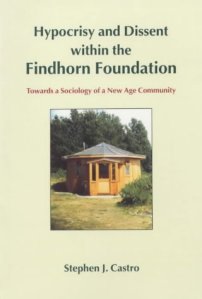
Stephen J. Castro, Hypocrisy and Dissent within the Findhorn Foundation: Towards a Sociology of a New Age Community (Forres, Morayshire: New Media Books, 1996).
This book provides an important insight into the disparity between the professed ideals and the actual reality of a New Age community; namely, the Findhorn Foundation in the far north of Scotland. As its subtitle indicates, it is intended as a contribution towards a sociology of such a community. The author has meticulously collected his data and presents it with notable perspicuity in an attempt to inform both sociologists and general public alike. Its broader significance lies, I believe, in the possible implications of the case in question for our perception of similar organizations.
The Findhorn Foundation is, as sociologist Eileen Barker has noted, ‘one of the best-known of the New Age communities in Britain’ (quoted p. xi). As such, its influence is considerable, having connections with similar communities worldwide. By 1993 the net worth of the Foundation’s properties was quoted at £l.6 million, and the commercial turnover for its trading arm, New Findhorn Directions, was said to be £1.2 million.
In the light of its charitable status, its material wealth, and its obvious prestige in the New Age milieu, it is rather startling to learn something of the modus operandi of this organization. Its members claim to receive the ‘direct guidance of God’. This is a highly questionable basis for the administration of any organization, especially when one learns later in the book the basis on which the claim rests. Yet the process of ‘attunement’ is used in the Foundation to this day, and is applied to the whole spectrum of decision making. The danger, as Castro points out, lies in the sense of infallibility that such a belief provides. Its implications are very serious, as this book reveals.
The Findhorn Foundation has had numerous dissenters. In addition to its very strained relations with the indigenous populations of Findhorn and Forres, a number of those who have had internal experience of the organization, including the author, have noted the disparity between preaching and practice in a community nominally devoted to love, truth, and spiritual growth.
Several cases are presented, but the most striking one is that of Kate Thomas, who first came into contact with the Findhorn Foundation in 1988. She wrote an additional 100-page chapter for her autobiography, containing a detailed record of her subsequent experience. Thomas entered fully into the life of the community, but became increasingly disconcerted as time passed. She discovered that this supposedly spiritual centre was actually devoted to commercial therapies, and not even in a professional manner, but applied indiscriminately, often by people without recognized academic qualifications. (Castro points out that this is possible in the UK, due to the absence of the stricter legal controls which are in evidence in other European countries.) Her mildly expressed protests drew mostly hostility, from authority figures and fellow participants alike, and she was subsequently labelled, by the former group, as a ‘troublemaker’. The situation was exacerbated by her stand against the introduction of Holotropic Breathwork™ in 1989 and by the publication of vol. 3 of her autobiography (with its additional material) in 1992.
Castro reveals Thomas as a person of great integrity, who was not willing to compromise principles in the face of injustice and hypocrisy. It seems that the more the members, and in particular the leaders, of the Foundation were confronted with their misdeeds, the more wilfully they refused to face up to them. Subsequently there was a great deal of publicity, at both local and national level. Among other significant events, we learn that the SCO commissioned a report by a forensic expert at Edinburgh University into the effects of hyperventilation, on the basis of which, in 1993, the Findhorn Foundation suspended its Holotropic Breathwork™ courses.
Kate Thomas was blocked from any closer involvement with the community, and even banned from its properties. She was never given an adequate explanation, nor a public hearing within the Foundation. Similar treatment was extended to anyone who supported her, and who likewise questioned the policies of those in positions of power. Castro points out that such censorship and aversion to criticism is typical of the cult mentality.
The book brings us up to 1995, with the situation still unresolved, at least to the satisfaction of the dissenters. In conclusion, I regard this as a timely publication. It provides material for a much needed investigation into the claims and activities, not just of the Findhorn Foundation, but of similar institutions in the New Age environment. Such institutions should not be exempt from sociological analysis. But one doesn’t have to be a sociologist to benefit from the book. Indeed, it is equally relevant to a general public in need of the sort of information it provides. Such information must become more widely available, if contemporary society is to be able to make a distinction between that which is genuinely spiritual and that which only masquerades as such.

 Reflections